
 Google AI
 ChatGPT
 Perplexity
Nearly $936 billion in commercial real estate debt is scheduled to mature in 2026, part of a broader wave of more than $1.5 trillion coming due across 2025 through 2027. Private credit is under its own strain: Fitch Ratings reported a record 9.2% default rate among private-credit-backed corporate borrowers in 2025. On the office side, a widely cited NBER study found that 44% of office loans were carrying negative equity, a figure drawn from December 2023 CMBS data that still shapes how lenders underwrite office deals today.
Traditional banks are backing away fast. Unprepared property owners are panicking. While average buyers run away, smart investors step in.
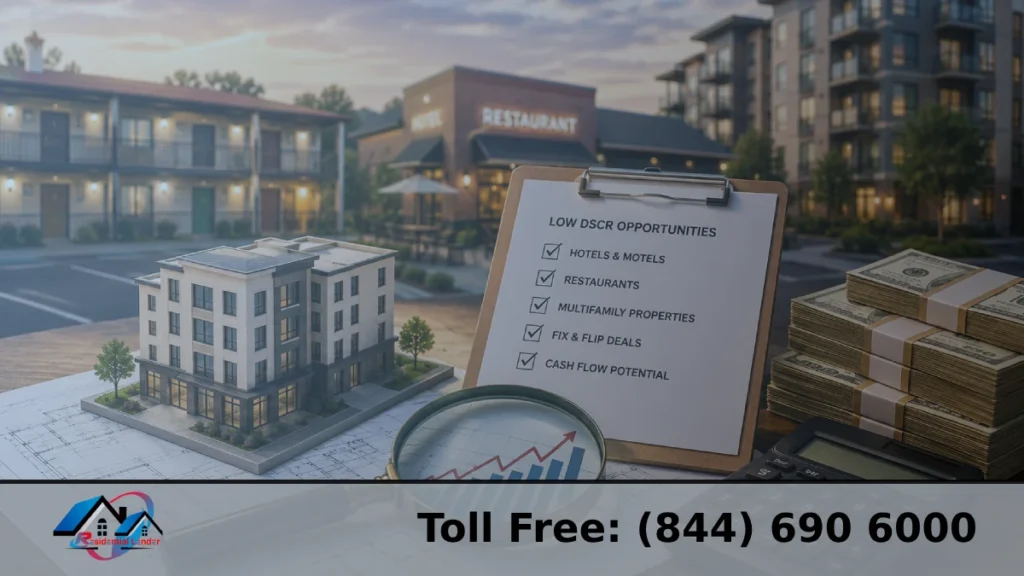
Right now is your single best chance to buy high-value real estate at massive discounts. Buying a low DSCR ratio investment property lets you acquire underperforming hotels, budget motels, busy restaurants, and rental units before the rest of the market catches on.
You do not need to let strict bank rules stop you. You just need the right funding options.
At Residentiallender.Net, we bring 30 years of underwriting experience to your side. As a correspondent lender and table lender, we give you access to 75 distinct loan programs. We don’t manage your business operations, but we can help you secure financing for land and construction, fix-and-flip deals, or long-term holdings.
Here is how you take control of your financial future today.
What Is a Low DSCR for Investment Property and How Is It Calculated?
To make money in this market, you must start by understanding low DSCR real estate investing.
Think of DSCR as a simple financial score. It shows whether a property earns enough money to pay its own mortgage bills.
Lenders calculate commercial DSCR by dividing Net Operating Income (NOI) by total annual mortgage payments:
DSCR = Net Operating Income / Annual Debt Payment
Net Operating Income is the cash left over after you pay all everyday expenses like taxes, repairs, and insurance, but before you pay your loan.
For residential 1- to 4-unit rental properties, lenders often divide gross monthly rent by monthly housing expenses (Principal, Interest, Taxes, Insurance, and Association fees, or PITIA):
DSCR (Residential) = Gross Monthly Rent / Monthly PITIA
If your rental property generates $10,000 every month and your mortgage payment costs 8,000,yourDSCRis1.25($8,000, you divide $10,000 by $8,000.
So, what is a low DSCR for investment property? Traditional banks want a ratio of 1.25 or higher. A ratio below 1.20 is considered low.
If the ratio falls below 1.00, the property loses money every single month. The income cannot cover the mortgage payment, so you must pay the rest out of your own pocket.
| DSCR Level | What It Means for Cash Flow | Bank Perception | Loan Options |
| Below 1.00 | Loses money monthly; negative cash flow | High Risk / Distressed | Hard money, bridge loans, no-ratio DSCR |
| 1.00 to 1.19 | Barely breaks even; zero safety cushion | Elevated Risk | Non-QM loans, interest-only options |
| 1.20 to 1.25 | Standard baseline; meets basic obligations | Acceptable | Standard investor loans and agency debt |
| 1.30 and Above | Strong profits; healthy buffer | Preferred / Low Risk | Unlocks top rates and lowest down payments |
Can You Handle the Impact of Low DSCR on Investment Property Cash Flow?
Evaluate the impact of low DSCR on investment property cash flow before making an offer. When a building operates on thin margins, small unexpected expenses can wipe out your monthly earnings. A slight spike in property taxes or insurance premiums can quickly drop a 1.10 ratio below 1.00.
In the hospitality sector, cash flow moves daily, and industry data shows a divided recovery between higher-end and budget lodging assets. If you acquire a small motel, restaurant, or recreation space with seasonal slowdowns, your cash flow will dip during slow months. Cash reserves protect your investment through these natural cycles.
What Are Standard Investment Property Mortgage Low DSCR Requirements?
Conventional bank investment property mortgage low DSCR requirements are tough. Standard banks usually demand a minimum DSCR of 1.25 for apartments and 1.40 or higher for hotels and motels.
| Property Type | Conventional Bank Target | Low DSCR Entry Program | Main Cash Flow Drivers |
| Residential Rentals (1-4 Units) | 1.20 to 1.25 | 0.75 to 1.00 (or No-Ratio) | Rent rates, local tenant demand |
| Commercial Space & Retail | 1.25 to 1.35 | 1.00 to 1.10 | Long-term leases, business sales |
| Hotels, Motels & Resorts | 1.40 to 1.50+ | Sub-1.00 (Bridge / Private) | Room rates (ADR), occupancy rates |
| Restaurants & Rec Spaces | 1.35 to 1.45 | 1.00 to 1.15 | Customer foot traffic, food costs |
When a property falls below standard bank guidelines, conventional lenders reduce your loan size or reject the file. That is why you need flexible loan structures built for lower coverage assets, such as a DSCR rental loan that qualifies on property income instead of tax returns.
What Are the Hidden Risks of Low DSCR Investment Property Deals?
Ignoring the risks of low DSCR investment property holdings leads to costly mistakes. Holding an asset with a low ratio brings three main dangers:
Default Risk: Low revenue makes it hard to pay debt when unexpected repairs pop up.
Refinance Risk: Traditional banks refuse to refinance properties with ratios under 1.20.
Personal Cash Strain: You must cover shortfalls using personal savings.
As the Harvard Business Law Review has explained, the gap between a maturing loan’s balance and what a lender is willing to refinance today, known as the equity gap, is what turns a manageable low DSCR property into a forced sale. You avoid these traps by picking the right loan product upfront. Interest-only periods, bridge loans, and cash reserves protect you while you rebuild property cash flow.
Can You Finance an Investment Property with Low DSCR Options?
If you are trying to figure out how to finance investment property with low DSCR challenges, non-traditional loan choices hold the answer. You do not need personal tax returns, W-2s, or pay stubs to qualify. Specialized lenders look at the asset value and potential income instead.
How Do Investment Property Loans Low DSCR and Alternative Financing Work?
We provide access to custom investment property loans, low DSCR packages that skip traditional red tape. If property income is tight right now, you can rely on alternative financing options for low DSCR rental property investments.
Flexible loan options include:
No-Ratio DSCR Loans: These loans completely ignore current cash flow ratios. You qualify based on property equity and credit history.
Lite-Doc & No-Doc Investor Loans: No personal tax return checks or personal debt ratio calculations.
Interest-Only Options: You pay only interest for the first 1 to 10 years. This lowers monthly bills and lifts your cash flow ratio right away.
40-Year Amortization Loans: Spreading loan payments over 40 years drops monthly debt service.
What Should You Know When Purchasing Investment Property with Low DSCR Loan Programs?
When purchasing investment property with low DSCR loan structures, quick action is key. Sellers often sell distressed hotels, motels, or rental properties cheap because of low current income.
We help you secure 75% to 80% Loan-to-Value (LTV) funding. This lets you buy fix-and-flip, fix-and-hold, or value-add real estate without tying up all your capital.
Why Consider Private Lenders Low DSCR Investment Property Programs?
Working with private lenders low DSCR investment property networks gives you speed and flexibility. Private capital sources care about property value and sponsor experience rather than endless paperwork.
Through Residentiallender.Net, you tap into private debt funds across the nation, including a private bridge loan structure built for maturing CMBS debt. Private loans offer:
Fast closings in as little as 7 to 14 days.
Short-term bridge capital to buy and repair real estate.
Capital set-asides to fund building renovations.
What Are the Best Low DSCR Commercial Investment Property Loans?
Securing low DSCR commercial investment property loans requires a capital provider who knows commercial real estate. Hospitality properties, like hotels, motels, resorts, and restaurants, require tailored funding structures.
We offer proven choices across the commercial sector:
SBA 7(a) and SBA 504 Loans: Great for owner-occupied hospitality properties, offering up to 90% financing.
USDA Business & Industry (B&I) Loans: Perfect for rural hotels, resorts, and commercial hubs.
CMBS Conduit Loans: Fixed, low interest rates for commercial properties.
Bridge & Construction Loans: Funding for land purchases, new builds, or total property remodels, structured as a non-recourse commercial loan where the deal calls for it.
| Commercial Loan Type | Max Leverage | Min DSCR Requirement | Ideal Use Case |
| Bridge Loans | 75% to 80% LTC | None / Sub-1.00 | Value-add deals, fix and flip, rehabs |
| Hard Money Loans | 65% to 70% LTV | Unrestricted | Quick cash closings, distressed deals |
| SBA 504 & 7(a) | 85% to 90% LTV | 1.15 to 1.25 | Owner-occupied hotels and restaurants |
| USDA B&I Loans | 70% to 80% LTV | 1.20 to 1.25 | Rural hotels, motels, and commercial hubs |
| CMBS Conduit Loans | 65% to 75% LTV | 1.25 to 1.35 | Stabilized lodging and commercial spaces |
Should You Refinance a Low DSCR Investment Property Right Now?
If you own real estate with tight cash flow, refinancing a low DSCR investment property can protect your asset. Refinancing swaps expensive short-term debt for stable, long-term financing. Oxford Economics has noted that rising debt costs are pushing interest coverage ratios to dangerously low levels across commercial real estate, which is exactly why acting before a balloon payment comes due matters.
When we refinance your property, we can switch you to an interest-only term or extend your repayment schedule. This lowers your monthly obligation and instantly boosts net cash flow.
How to Improve DSCR for Investment Property Holdings Quickly?
If you want to learn how to improve DSCR for investment property assets, focus on two simple goals: increase gross revenue or lower monthly expenses.
Actionable ways to raise your score include:
Raise Rents or Daily Rates: Bring room rates or tenant rents up to local market averages.
Monetize Extra Amenities: Charge for parking, rent out storage space, or add guest laundry facilities.
Reduce Vacancies: Improve property marketing to fill empty rooms or rental units faster.
Cut Operating Costs: Renegotiate vendor contracts, install energy-efficient lighting, and dispute high property tax assessments.
Buy Down Interest Rates: Pay upfront points to lock in a lower mortgage rate and reduce your monthly debt bill.
What Are Proven Strategies for Maximizing Investment Property Income Low DSCR?
Using smart strategies for maximizing investment property income low DSCR turns weak assets into top earners.
For hotel and lodging properties, completing a targeted Property Improvement Plan (PIP) drives up room demand. Refreshing guest rooms and lobbies lets you charge higher daily room rates.
For commercial rental spaces, switching tenants to Triple Net (NNN) leases makes tenants pay for taxes, insurance, and maintenance. This directly reduces property expenses and elevates Net Operating Income.
Low DSCR Ratio Investment Property Solutions: Why Work with Residentiallender.Net?
When closing tough real estate transactions, finding the best lenders for low DSCR investment property assets makes all the difference. You need a funding partner who understands real estate underwriting inside out.
That partner is Residentiallender.Net.
Who We Are
We specialize exclusively in real estate investment properties. We focus heavily on residential investment property, rental property, distressed residential property, along with general commercial real estate. We bring 30 years of underwriting experience to every file.
We operate as a correspondent lender, table lender, and super broker. While we do not act as underwriters, our 30 years of underwriting experience helps us package and position your loan for rapid approval.
What We Offer
75 Loan Options: We connect you to private investors, institutional debt funds, and government programs.
Complete Real Estate Support: We assist with land acquisitions, ground-up construction, fix-and-flip, fix-and-hold, fix-and-rent, and refinances designed to close fast.
Comprehensive Loan Selection: We provide bridge loans, hard money, DSCR loans for rental property, no-doc, lite-doc, SBA, USDA B&I, CMBS, FHA commercial, construction-to-perm, Fannie Mae, and Freddie Mac loans.
Financial Consulting: We provide financial advice for people entering real estate or training to become hospitality real estate brokers.
Broker Referral Programs: We offer exclusive and non-exclusive referral programs for new and experienced real estate brokers.
Please note: We only provide real estate investment property financing. We do not manage or operate your daily business.
Seizing Opportunity in Low DSCR Ratio Investment Property Assets
Buying or holding a low DSCR ratio investment property does not have to limit your financial growth. While traditional banks reject deals with tight cash flow, experienced investors see these properties as major wealth builders. By choosing flexible financing structures, you can acquire valuable real estate, increase monthly earnings, and grow portfolio equity.
Do not let bank rejections delay your investment goals. Put our 30 years of underwriting experience to work for you.
Contact our team at Residentiallender.Net today to discuss your next transaction, explore our 75 loan options, or join our broker referral program. Let us help you unlock your property’s full earning power right now.
FAQs
Can bad credit stop a low DSCR loan?
No. You can win even with lower credit scores down to 640. Our private lenders look at your property cash flow and real estate equity instead. Call Residentiallender.Net now to lock in your deal fast.
Does seller financing help fix low DSCR deals?
Yes. A seller carryback loan lowers your main debt payment immediately. This simple approach fixes your coverage ratio so you qualify for better rates. Contact Residentiallender.Net right now to structure your deal.
Do lenders check personal tax returns for approval?
No. You do not need to show any tax returns or pay stubs. Our private programs focus on property performance and asset value. Reach out to Residentiallender.Net now to grab your fast quote.
Can you use projected rent for low DSCR?
Yes. You can use an appraiser’s market rent report to prove future income on empty or renovated properties. Contact Residentiallender.Net right now to start your loan application.
Will low DSCR loans require higher cash down?
Yes. Lenders usually require a 20% to 25% down payment to balance out lower cash flow risk. You still keep full ownership and protect your liquid reserves. Call Residentiallender.Net today to secure your custom rate.