 Google AI
 ChatGPT
 Perplexity
The short-term rental market is growing fast. Depending on the research firm, the global short-term rental market sits between $140 billion and $154 billion this year, with some forecasts pointing past $400 billion by 2035. Estimates vary by firm and methodology, but every major forecaster agrees on the direction: up, and quickly.
Every weekend, thousands of travelers pay $250 to $600 a night to stay in private beach houses, mountain cabins, and city lofts.
Smart investors are buying these cash-flowing properties right now.
Yet when you walk into a traditional bank to buy a profitable Airbnb, the loan officer often turns you down.
Why? Because traditional mortgage lenders look at your personal tax returns. If you are a smart business owner or real estate investor, your CPA writes off your expenses to save you money on taxes. On paper, your personal income looks small. The traditional bank calls you high risk and denies your loan.
You miss out on a property that makes thousands of dollars in profit every month.
There is a better way to finance your properties. You do not need to show W-2s, pay stubs, or tax returns to build a vacation rental portfolio. You can use DSCR loans for short-term rental properties to fund your next deal based entirely on the property’s cash flow.
At ResidentialLender.Net, we bring 30 years of underwriting experience to your side. We operate as a correspondent lender, table lender, and super broker. We connect you to dozens of loan options across our private network.
We do not run your day-to-day hospitality operations. We provide the capital and financing advice you need to secure the real estate. Whether you want to buy raw land, build from the ground up, fix and flip, or buy and hold single-family homes, townhouses, multifamily property, and luxury vacation rentals, we help you get funded.
Let us walk through how you can use these loans to buy, grow, and protect your short-term rental portfolio.
Can You Really Buy an Airbnb Without Showing Paystubs?
Yes.
When you apply for a no-income-verification DSCR loan for a short-term rental, the lender does not look at your job. The lender does not ask for your personal tax returns. They do not care how much money you made at your day job last year.
They care about one question: does the property make enough money to pay its own bills?
DSCR stands for Debt Service Coverage Ratio. It compares the property’s gross rental income to its monthly mortgage payment.
Think of the property as its own small business. If the house makes $5,000 every month from guests, and the total monthly loan payment is $3,500, the property covers itself.
Because the real estate generates its own cash flow, the lender qualifies the asset instead of your personal salary. This single rule changes everything for self-employed workers, gig workers, full-time investors, and business owners. You no longer have to explain your tax write-offs to a skeptical underwriter. Our DSCR loan requirements breakdown covers exactly what documentation you still need.
How DSCR Loans Work for Vacation Rentals
A standard long-term rental uses a 12-month signed lease. A tenant pays a fixed rent check on the first of every month.
Short-term rentals do not work that way. Your income changes with the season, local holidays, and weekend travel. You might make $8,000 in July and $3,000 in November.
Lenders use three main methods to calculate your rental income:
Market Data from AirDNA or Rabbu. For new purchases or properties with no rental history, lenders pull projected Average Daily Rates and occupancy rates from industry databases.
Platform Hosting Reports. If the property is already an active Airbnb or VRBO, lenders review trailing 12-month revenue statements from the host dashboard and match them against bank deposits.
Appraiser Short-Term Rental Income Analysis. The lender orders an appraisal. The appraiser studies comparable vacation rentals nearby to project annual gross revenue.
The Underwriting Haircut
Running an Airbnb takes real work and ongoing costs. You pay for professional cleaning, platform booking fees, guest supplies, utilities, and property management. A Forbes Business Council contributor puts annual maintenance and repairs at roughly 5% to 8% of gross rental revenue, in line with typical industry guidance.
Because of these costs, lenders apply a standard 20% to 25% expense cut, often called a haircut, to your projected gross revenue.
If your property is projected to make $60,000 a year ($5,000 a month), the lender applies a 20% haircut. They calculate your qualifying monthly income at $4,000. They then compare that $4,000 to your total monthly debt payment.
How Do You Calculate DSCR for a Short-Term Rental?
Divide the monthly rental income by the complete monthly mortgage payment.
Your complete monthly mortgage payment is called PITIA:
- P: Principal, the loan balance you pay back
- I: Interest, the lender’s fee
- T: Taxes, local property taxes
- I: Insurance, hazard, flood, and short-term rental liability coverage
- A: Association dues, HOA fees if applicable
DSCR Ratio = Qualifying Monthly Rental Income ÷ Total Monthly Housing Payment (PITIA)
A Real-World Numbers Example
- Purchase Price: $450,000
- Down Payment (25%): $112,500
- Loan Amount (75% LTV): $337,500
- Interest Rate: 7.50% (30-Year Fixed)
- Monthly Principal & Interest: $2,360
- Taxes, Insurance & HOA: $640
- Total Monthly Payment (PITIA): $3,000
Vacation rental income:
- Projected Gross Monthly Revenue (AirDNA): $5,000
- Lender Expense Deduction (20% haircut): -$1,000
- Qualifying Monthly Income: $4,000
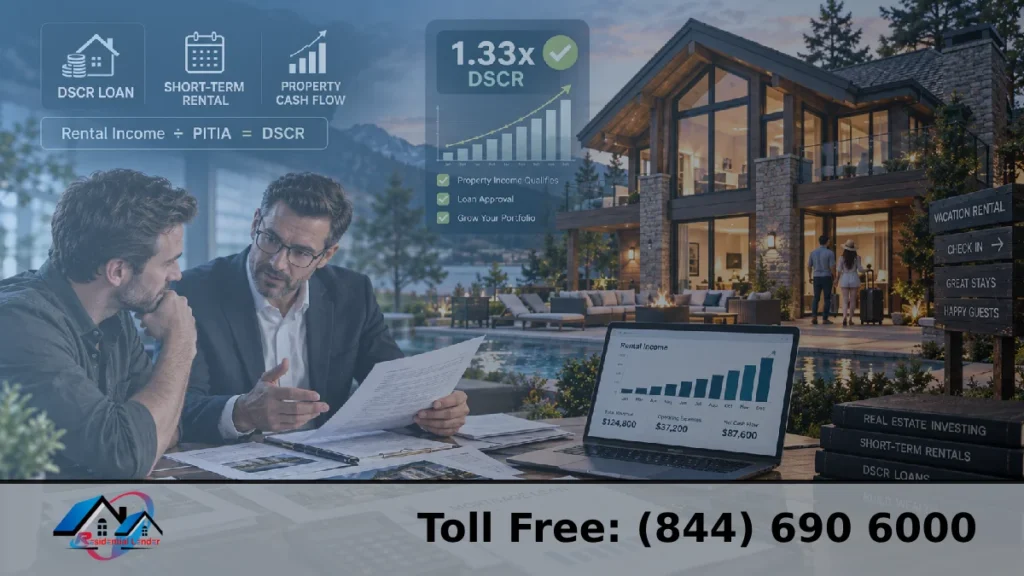
DSCR = $4,000 ÷ $3,000 = 1.33x
Your DSCR ratio is 1.33. Because the score is above 1.25, the loan is approved. The property makes 33% more money than it costs to own.
| DSCR Coverage Tier | Ratio Range | Underwriting Status | Typical Terms & Leverage |
| Prime Coverage | 1.30x and higher | Fastest approval | Lowest rates, up to 80% LTV |
| Standard Baseline | 1.20x to 1.29x | Full approval | Standard rates, 75% to 80% LTV |
| Breakeven Floor | 1.00x to 1.19x | Conditional approval | Moderate rates, 70% to 75% LTV |
| Negative Cash Flow | Below 1.00x | Restricted program | Higher rates, 30% to 35% down |
If your ratio comes in low on a strong property, look at our guide on managing a low DSCR ratio investment property before you walk away from the deal.
DSCR Loan Requirements for Short-Term Rental Properties
You don’t need tax returns, but lenders still review the real estate asset, your credit history, and your liquid cash reserves.
Credit Score Thresholds
- 640 to 679 FICO: Minimum qualifying range; may require 25% to 30% down
- 680 to 719 FICO: Solid tier, unlocks standard market rates and 75% to 80% leverage
- 720+ FICO: Prime tier, unlocks the best rate spreads and lowest origination fees
Down Payment Requirements
Most lenders ask for 20% to 30% down. On a $400,000 vacation home, 20% down equals $80,000, and 25% down equals $100,000. A larger down payment lowers your monthly payment, which strengthens your DSCR ratio and can unlock a better rate.
Liquidity Reserves
Lenders want proof you can cover the mortgage during a slow winter or rainy season. Most require 6 to 12 months of PITIA payments in your checking, savings, or brokerage accounts, after your down payment and closing costs. On a $3,000 monthly payment, a 6-month reserve requirement means showing $18,000 in verifiable liquid funds. You keep this money in your own account; the lender does not take it.
Our full DSCR mortgage requirements guide covers entity documentation, seasoning rules, and appraisal standards in more depth.
DSCR vs. Conventional Loan for Short-Term Rentals
Conventional loans backed by Fannie Mae and Freddie Mac were built for families buying a home to live in, not for hospitality investors.
| Feature | DSCR Loan | Conventional Mortgage |
| Income Verification | No personal income documentation | W-2s, two years of tax returns, pay stubs |
| Underwriting Driver | Property cash flow (DSCR) | Personal debt-to-income ratio |
| Entity Borrowing | LLCs, corporations, partnerships, trusts | Personal name only |
| Portfolio Scalability | No hard property cap | Capped near 10 financed properties |
| Down Payment Range | 20% to 30% | 15% to 25%, strict DTI limits |
| Closing Speed | 21 to 25 business days | 45 to 60-plus business days |
| Short-Term Income Credit | Uses AirDNA, host logs, and STR comps | Often rejects STR data |
Conventional guidelines count your car payments, student loans, and credit cards against you, and cap you at roughly 10 financed properties. DSCR loans have no property limit. You can buy 5, 20, or 100 vacation rental properties as long as each one produces enough cash flow to cover its own debt. See our no income verification rental loan breakdown to learn how that qualification path works across property types.
Benefits of DSCR Loans for Short-Term Rental Investors
Close inside an LLC for asset protection. Conventional loans require you to buy in your personal name, which exposes your personal assets to guest slip-and-fall lawsuits. DSCR loans let you close directly inside an LLC or corporation.
Faster closings. Traditional underwriting takes 45 to 60 days and requires extensive document requests. DSCR loans can close in as little as 21 to 25 days, which helps you win competitive deals in hot vacation markets.
Cleaner personal credit profile. Most commercial DSCR loans do not report monthly balances to your personal consumer credit report.
A repeatable growth loop. Buy a property, grow its bookings, let it appreciate, pull cash out, and buy the next one. Repeat every two to three years to build long-term wealth.
DSCR Loan Interest Rates and Closing Costs for Short-Term Rentals
Because DSCR lenders take on more risk by skipping personal income verification, rates run somewhat higher than conventional residential loans. As of mid-2026, short-term rental DSCR rates broadly range from about 6.5% to 9.5%, depending on your credit score, down payment, market, and the property’s cash flow. Rates move with the broader rate environment, so always confirm current pricing before locking anything in.
Many investors choose a 30-year fixed loan for payment stability. Others choose a 10-year interest-only structure, which cuts the monthly payment by 15% to 25% during the interest-only period, boosting cash flow and the DSCR ratio in the near term.
Closing Costs
Closing fees generally run 1.5% to 3.5% of the loan amount:
- Lender origination points: 0.5% to 1.5% of the loan amount
- Commercial appraisal fee: $600 to $1,500
- Title search and lender title insurance: $1,500 to $3,000, depending on the state
- Legal and settlement processing: $800 to $1,500
- Property tax and insurance escrows: 3 to 6 months prepaid
Prepayment Penalties
Most DSCR loans include a prepayment penalty. The most common structure is a 3-2-1 step-down: 3% if you pay off or refinance in year one, 2% in year two, 1% in year three, and no penalty after that.
Seasoning Requirements Before You Refinance
One thing many guides skip: how long you have to hold a property before you can pull cash out of it. Most lenders require 6 to 12 months of “seasoning,” meaning you own the property for that period before they will use an appraised value for a cash-out refinance instead of your original purchase price. Some programs offer delayed-financing exceptions within the first 90 days if you bought the property in cash. Ask about seasoning terms before you assume a quick cash-out timeline is available.
Common Challenges Getting a DSCR Loan for Short-Term Rentals
Local city regulations and zoning bans. Cities change the rules often. A National Bureau of Economic Research working paper found that when Chicago began receiving detailed data feeds from booking platforms to enforce its short-term rental ordinance, active listings dropped 16.4% compared to control cities. Separate research on Los Angeles County, discussed by the Center for Economic Policy Research, found that cities adopting Home Sharing Ordinances saw listings fall by roughly 50%. Always check local zoning laws, permit caps, and licensing rules before you sign a purchase contract. Markets with unclear or shifting STR rules (parts of Los Angeles, Chicago, New York City, and several Florida coastal towns among them) deserve extra diligence before you commit earnest money.
Strict HOA rules. Many homeowner associations ban leases shorter than 30 or 90 days. If the HOA prohibits short-term guests, the lender will reject short-term income calculations.
Aggressive underwriting haircuts. If you buy in a seasonal market where the home sits vacant for four months, the lender’s 20% to 25% expense haircut might push your DSCR ratio below 1.0. Below that line, you may need to put down 30% to 35% to get approved.
Unpermitted additions. If a seller built an unpermitted guest house or converted a garage without city permits, appraisers cannot count that square footage toward your rental income.
We review these items before underwriting starts so you avoid surprises and protect your earnest money deposit.
Home Value Effects: What the Research Actually Shows
Short-term rentals do not affect home values the same way everywhere. Early, broad studies covering New York and the wider United States found appreciation effects as large as 17% to 20% in markets where short-term rental supply roughly doubled over about four years. Later research that controlled for market popularity and other local factors found a much smaller, positive effect, generally between 1% and 4%, concentrated in specific touristic areas. Harvard Business Review has covered this research directly, noting that short-term rentals tend to produce mostly positive effects on nearby home values. At the same time, their impact on broader housing costs is more mixed and market-specific.
The lesson for investors: appreciation from short-term rental activity is real in many tourist markets. Still, it varies widely by location, so don’t assume a single national number applies to your target property.
Can a First-Time Investor Qualify for an Airbnb Loan?
Yes. Being a first-time investor does not stop you from getting approved for a DSCR loan.
If you do not have a track record of owning rental properties, lenders may ask for two safety items: a credit score of 680 to 700 or higher, and 25% down instead of 20%.
Qualifying as a beginner comes down to picking the right market. Look for locations near national parks, beach towns, major hospital centers, or sports complexes. Pick a home with strong demand, run the numbers through AirDNA, and line up your financing before you make an offer.
DSCR Loans for Multi-Unit Short-Term Rental Properties
Single-family homes make great vacation rentals, but multi-unit properties reduce vacancy risk. If you own a single-family cabin and it sits empty for a week, you earn nothing that week. If you own a 4-unit building and one unit sits empty, the other three keep generating income.
At ResidentialLender.Net, we finance 1- to 4-unit residential properties as well as larger commercial hospitality assets: boutique hotels, roadside motels, glamping resorts, and condotels. We structure loans for raw land purchases, ground-up construction, and full renovations across all 50 states.
Refinancing a Short-Term Rental with a DSCR Loan
If you already own an operating vacation rental, refinancing with a DSCR structure lets you pull out cash and grow your portfolio.
Rate-and-Term Refinance. Replace an expensive hard money or bridge loan with a 30-year fixed DSCR loan to lower your monthly payment.
Cash-Out Refinance. Pull equity out of your property in cash, up to 75% or 80% of the appraised value, and use it as a down payment on your next property.
If your property has generated 12 months of strong Airbnb revenue, we use your actual platform earnings statements to help maximize your property’s value and cash-out limit.
How to Get Pre-Approved for Your DSCR Loan
Step 1: Identify Your Property Target. Find a high-performing vacation home, multi-unit building, or boutique lodging property. Gather projected revenue reports from AirDNA or historical booking statements.
Step 2: Request Your Term Sheet. Contact our team at ResidentialLender.Net. We evaluate your deal and deliver a custom term sheet within 24-48 hours.
Step 3: Complete Property Due Diligence. We order the appraisal, verify local short-term rental permits, and review your entity documents. No personal tax returns or pay stubs required.
Step 4: Close and Fund Your Deal. We fund your loan in 21-25 days. You take ownership, launch your listings, and start collecting guest revenue.
Take Action Today
The short-term rental sector is growing quickly, and forecasts consistently point toward continued expansion over the next decade, even though exact figures vary by research firm. Institutional investors and private buyers are acquiring top-producing properties across major travel markets right now.
Do not let personal tax returns, debt-to-income limits, or bank bureaucracy hold back your real estate goals. Deploy a DSCR loan for your short-term rental, protect your personal liability inside an LLC, and scale your cash flow.
Contact ResidentialLender.Net today to speak with our hospitality lending specialists, explore our loan options, and see what you can get approved for. You can also browse our best DSCR loan lenders for rental properties comparison if you want to see how different programs stack up before you apply.
FAQs
Can foreign investors get a DSCR loan?
Yes. You do not need US citizenship or a green card. We approve foreign buyers using passport identification and global assets.
Can you live in your DSCR property?
No. These loans are for business investments that generate rental income, not owner-occupied homes.
Can you use gift money for a down payment?
Yes. You can use gift money from family or business partners for your down payment with a basic gift letter.
Can sellers pay your DSCR closing costs?
Yes. Sellers can typically contribute up to 6% of your total closing costs, keeping more of your cash available to furnish and launch the rental.
Do rural vacation cabins qualify for DSCR loans?
Yes. Mountain cabins and rural retreats qualify if they generate steady, documentable tourist revenue.