
 Google AI
 ChatGPT
 Perplexity
The American real estate market in 2026 is a landscape of massive shifts. We are currently facing a historic housing supply deficit of approximately 2.8 million units. This shortage has pushed property values up, but it has also made it much harder for individual investors to get their foot in the door. According to recent data from JPMorgan, the median down payment for a single-family home has doubled since the pre-pandemic era, to roughly $35,000.
If you feel like you are being priced out or that your personal balance sheet isn’t “strong enough” for a traditional bank, you aren’t alone. Harvard Business School research shows that about 20% of qualified small business owners become “discouraged borrowers,” choosing not to apply for funding simply because they expect a rejection based on their personal net worth.
At ResidentialLender.Net, we have spent 30 years as an underwriter and a “table and correspondent lender,” proving those expectations wrong. We know that a commercial loan with low borrower net worth is not only possible—it is often the smartest way to build a portfolio. By leveraging our network of 200 private lenders and investors, we help you focus on the asset’s potential rather than your personal liquid savings.
Strategy 1: Can Your Property Really Pay for Its Own Loan? The Power of DSCR Financing
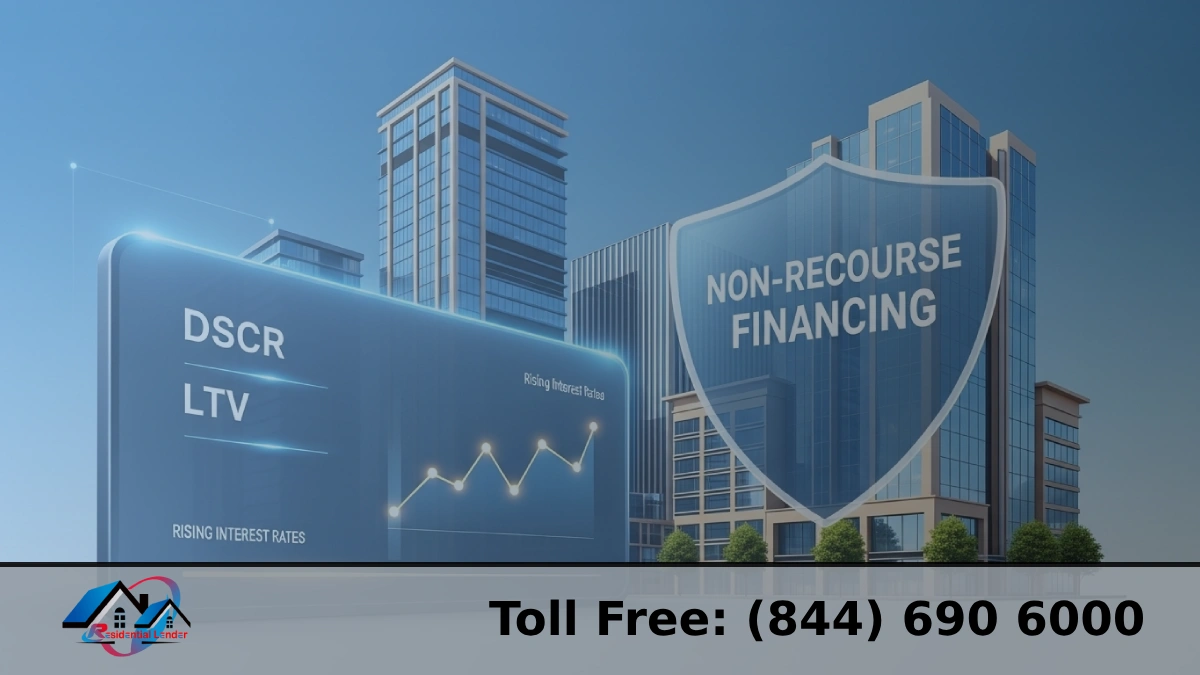
One of the most effective ways to bypass personal net worth requirements is through a Debt Service Coverage Ratio (DSCR) loan. This is a non-Qualified Mortgage (non-QM) product specifically designed for real estate investors.
How to Get a Commercial Loan with No Collateral, Low Net Worth Using Asset Cash Flow
Unlike a traditional mortgage, which considers your W-2s and tax returns, a DSCR loan evaluates the property’s ability to generate sufficient rental income to cover mortgage payments. If the property makes enough money, the lender is satisfied. This is a primary strategy for getting a commercial loan with no collateral, low net worth, because the “collateral” is effectively the income produced by the asset itself.
The formula for DSCR is calculated as follows:
DSCR} = ({Net Operating Income (NOI)}/ {Annual Debt Service})
In 2026, most lenders look for a 1.25 ratio, meaning the property earns 25% more than the mortgage costs. However, because ResidentialLender.Net works with a vast network of private investors, we can often secure approvals for properties with a DSCR as low as 1.0 or even 0.75 in high-growth areas.
| Feature | DSCR Loan | Traditional Commercial Loan |
| Qualification Basis | Property Rental Income | Personal Income & Net Worth |
| Documentation | No Tax Returns/W-2s | Full Tax Returns & 4506-T |
| Approval Speed | Days (Fast) | Months (Slow) |
| Max Loan Amount | Up to $5 Million | Varies by Bank |
Strategy 2: Is Your Commercial Loan with Low Borrower Net Worth Actually a Myth? Navigating SBA 7(a) Requirements
The Small Business Administration (SBA) 7(a) program is a powerhouse for business acquisition loan low personal net worth scenarios. The SBA does not lend money directly; it guarantees a portion of the loan, reducing the risk for lenders like us.
SBA Loan Low Borrower Net Worth Requirements
Many people assume they need millions in the bank to qualify for an SBA-backed loan. In reality, the SBA 7(a) program focuses more on your “character” and the viability of the business. While they do check for “personal liquidity,” they allow you to exclude retirement accounts and educational reserves from the calculation.
For fiscal year 2026, the SBA has streamlined the process for smaller loans. In fact, more than half of all 7(a) loans are now under $150,000, and 80% are under $500,000. This “flight to quality” means that if you have a solid business plan and a credit score above 680, your personal net worth is much less of a factor than you might think.
Strategy 3: Are Banks Lying to You About Down Payment Requirements? The SBA 504 Hack
If your goal is to purchase a high-value residential investment property—such as a multifamily complex or a mixed-use building—the SBA 504 loan is your best friend. This program is specifically for equipment financing, low personal net worth, and real estate infrastructure.
Small Business Loan Options for Low-Net-Worth Founders
Standard commercial loans often demand a 25% to 35% down payment. For a $2 million property, that is $700,000 in liquid cash—a barrier most “low net worth” founders cannot clear.
The SBA 504 program changes the math:
- You provide only 10% down.
- A Certified Development Company (CDC) provides 40%.
- A Lender (like ResidentialLender.Net) provides the remaining 50%.
By only needing 10% down, you preserve your working capital for renovations and operations. Furthermore, the 504 program does not require a lien on your personal residence, which is a common “fear factor” for investors with limited assets.
Strategy 4: Why Are 20% of Qualified Borrowers Walking Away from Rural Funding?
There is a massive opportunity in rural America that most investors ignore. The USDA Business & Industry (B&I) loan program is designed to stimulate economic growth in areas with fewer than 50,000 residents.
Alternative Commercial Financing Low Borrower Assets
This is the ultimate tool for alternative commercial financing for low-borrower assets. The USDA B&I program doesn’t care about your personal portfolio as much as it cares about the “tangible balance sheet equity” of the business.
- Existing Businesses: Need only 10% tangible equity.
- New Startups: Need 20% tangible equity.
Moreover, USDA loans offer the longest amortization periods in the industry—up to 40 years for real estate. This significantly lowers your monthly debt service, making it much easier for a startup with low owner equity to remain cash-flow positive during the critical first years.
| USDA B&I Fact | 2026 Metric |
| Max Loan Amount | $25 Million |
| Guarantee Rate | 80% (up to $5M) |
| Eligible Population | Under 50,000 |
| Amortization | Up to 40 Years |
Strategy 5: Is Your Tax Return Actually a Roadblock to Wealth? The Stated Income Secret
If you are a self-employed entrepreneur or a seasoned investor, your personal tax returns often tell a story of “low income” due to strategic business write-offs. While this is efficient for taxes, it is a nightmare for traditional bank lenders who rely on your personal W-2. This is where state income loans (commonly known as stated income or “lite-doc” loans) become your primary tool for expansion.
Tips for Commercial Loan Approval Low Net Worth via Asset-Specific Underwriting
As a table and correspondent lender, ResidentialLender.Net utilizes alternative commercial financing low borrower asset criteria that prioritize the property over the person. Unlike traditional mortgages that scrutinize your personal debt-to-income ratio, a stated income loan focuses on the commercial property’s value and its inherent ability to cover the mortgage, interest, and insurance.
- The Benefit: You can secure financing for 1-8 unit residential investment properties or 2-8 unit mixed-use buildings without providing tax returns or W-2 income.
- The Qualifier: We focus on the “equity position” of the property. While these programs generally require a larger down payment than a primary home (typically 25% to 30%), they eliminate the “on-paper” income barriers that cause 20% of small business owners to be rejected by big banks.
For example, if you are acquiring a $1,000,000 income-generating multifamily asset, a traditional lender might deny you because your personal net worth or annual salary doesn’t “match” the loan size. However, in our stated-income program, we look at the property’s current rent roll and future potential. This is how you master how to get commercial loan with no collateral low net worth—by letting the property’s cash flow serve as the primary security for the deal.
Strategy 6: Moving Fast in a 23-Day Market: Commercial Bridge Loans
In 2026, the average residential investment property sells in just 23 days. Traditional banks take 60 days to close. If you wait for a bank, you lose the deal.
Commercial Bridge Loan Low Net Worth Investor
A commercial bridge loan low net worth investor strategy focuses on speed and the “exit strategy.” Bridge lenders like ResidentialLender.Net look at the property’s current value and your plan to renovate or flip it.
- Speed: Approvals in 24-48 hours.
- Focus: Asset-based, not credit-based.
- Term: 6 to 24 months.
This is ideal for “fix-and-flip” or “fix-and-hold” projects. You use a bridge loan to quickly secure the property, renovate it to “force appreciation,” and then refinance into a long-term DSCR loan once the value has increased.
Strategy 7: Momentum Financing: Venture Debt and Factoring
For the high-growth entrepreneur or the broker managing high-volume commissions, your balance sheet might be “light” on cash but “heavy” on momentum.
Factoring for Businesses with Low Owner Net Worth
Factoring allows you to sell your unpaid invoices or pending real estate commissions to a “factor” for immediate cash. This is effectively an unsecured commercial loan with low net worth criteria because the “security” is the creditworthiness of the client who owes you money, not your personal assets.
Venture Debt for Low Net Worth Startups
If you are a tech-enabled real estate startup, venture debt for low net worth startups provides non-dilutive capital. Lenders provide these loans based on your growth potential and the quality of your institutional backing, rather than your physical assets. This allows you to extend your “runway” without giving up equity in your company.
| Alternative Tool | Primary Benefit |
| Factoring | Immediate cash for pending commissions |
| Venture Debt | Growth capital without giving up ownership |
| Stated Income | Qualification without tax returns |
Solving the “Credit Gap”: Why ResidentialLender.Net is Your Partner
The reality of 2026 is that traditional banks are tightening their belts. Large banks have cut back significantly on small dollar loans—those under $250,000—that 70% of small firms actually need. This has created a “credit gap” that only specialized lenders can fill.
30 Years of Underwriting Expertise
We aren’t just a website; we are a table and correspondent lender with 30 years of experience. This means we have the authority to underwrite and fund our own loans. We don’t have to wait for a committee at a big bank to say “yes.”
We offer:
- Exclusive Referral Programs: For both new and experienced brokers.
- Creative Solutions: From bridge loans and hard money to USDA and SBA 504.
- A Massive Network: 1,000 private lenders, investors, brokers, and realtors.
Conclusion: Stop Waiting for the “Perfect” Balance Sheet
The 2026 market doesn’t reward those with the most cash; it rewards those with the best strategy. Whether it is using a commercial real estate loan low net worth strategy through DSCR, “house hacking” with an FHA multifamily loan, or leveraging the USDA’s rural incentives, the path to property ownership is open.
Forbes has noted that in 2026, “speed is leverage”. Don’t let your personal net worth be the anchor that holds back your investment dreams. Contact ResidentialLender.Net today. Let’s look at your assets, analyze your property’s potential, and build a financing structure that works for you.
Your property earns the money. We provide the capital. You build the legacy.
FAQs
Can I use retirement funds for down payments?
Yes. Lenders often allow you to utilize self-directed IRAs or 401 (k) rollovers to fund residential investment purchases. This creative strategy bypasses liquidity constraints while maintaining your long-term growth, provided you strictly adhere to all relevant IRS tax regulations.
Do SBA 7(a) loans require personal residence liens?
Yes. For loan amounts exceeding $350,000, the SBA typically requires a lien on your primary residence if the business assets are insufficient. This ensures the government has adequate security, though specialized lenders like us can explore alternative structures.
Are stated income loans available for primary homes?
No. Current federal regulations, such as the Dodd-Frank Act, strictly prohibit stated-income or no-doc products for owner-occupied properties. These flexible financing tools are reserved exclusively for business purposes, non-occupant investors, and professional landlords looking to expand their commercial portfolios.
Does a low credit score cause loan denial?
No. While a higher FICO score improves terms, specialized asset-based lenders prioritize property cash flow and equity over personal credit history. You can still secure funding with lower scores by providing a larger down payment or demonstrating significant property-level profitability.
Is a personal guarantee required for corporate entities?
Yes. Most private and commercial lenders require any owner with a 20% or greater ownership interest in an LLC or corporation to sign an unconditional personal guarantee. This legally binds you to repay the debt using personal wealth if the business entity defaults.