
 Google AI
 ChatGPT
 Perplexity
If you own residential investment properties like apartment buildings, mixed-use units, or a portfolio of rental homes and your current Commercial Mortgage-Backed Security (CMBS) loan is coming due, you are likely facing one of the trickiest financial situations in modern real estate. The challenge isn’t just finding a new loan; it’s finding one that works in today’s demanding market.
In the world of real estate investing, few things are as stressful as an approaching balloon payment that your current property can’t seem to refinance through traditional channels. You need a fast, flexible solution to protect your asset, stabilize its income, and prepare it for long-term financing.
This is where a private bridge loan for maturing CMBS debt steps in as your essential lifeline.
At ResidentialLender.Net, we have spent 30 years as underwriters helping investors navigate these exact moments. We specialize in providing the speed and customized funding that securitized debt situations demand. This detailed guide will walk you through the current crisis, explain the mechanics of a CMBS maturity trap, and show you exactly how private capital can provide the CMBS loan default private bridge loan solution you need.
Understanding the CMBS Maturity Wall: Risks of Maturing CMBS Without Bridge Financing
The commercial real estate market is currently at peak maturity, often referred to as the “maturity wall.” For investors holding securitized debt such as CMBS loans this event is causing significant stress, especially for transitional assets that are not yet fully stabilized. You might own a thriving residential portfolio, but the nature of CMBS debt makes refinancing a hurdle.
The $957 Billion Problem: Why Your CMBS Loan Needs a Plan
The financial figures confirm the challenge: across the U.S., nearly $957 billion in commercial real estate loans are scheduled to mature in 2025 alone. This massive volume is almost triple the historical average. When this much debt comes due all at once, the conventional lending market gets clogged and highly restrictive.
For CMBS debt specifically, the pressure is even more acute. CMBS loan delinquency rates are nearly six times higher than those of traditional bank loans. This means the securitized debt market is flashing a significant warning sign.
What does this mean for your residential investment properties?
If your CMBS loan is maturing, you face several serious risks of maturing CMBS without bridge financing:
- Forced Cash-In Refinance: Because interest rates are higher today than when your CMBS loan was originated, your new loan amount might not be enough to pay off the old one. This is because higher rates mean higher payments, which your property’s current income might not support, forcing you to bring extra cash to the closing table.
- Special Servicing Nightmare: If you can’t pay off the balloon payment or secure a refinance, your loan enters “special servicing.” The special servicer’s job is to maximize recovery for bondholders, not to prioritize your financial well-being. This can lead to costly fees, challenging workouts, and potentially foreclosure.
- Defeasance or Yield Maintenance Penalties: CMBS loans famously have rigid prepayment penalties. Suppose you try to exit the loan early (even to refinance). In that case, you often face “yield maintenance” or “defeasance,” which can add high, unexpected costs to your transaction.
Suppose you are invested in multifamily properties or mixed-use assets. In that case, the market remains strong, but your loan’s structure may still put you in a bind. You need a fast, surgical capital injection that bypasses the glacial speed and rigidity of traditional banks and special servicers. This is the definition of the short-term, private capital we specialize in.
The CMBS Loan Default: Why Traditional Refinancing Fails Your Property
The reason so many performing assets are struggling to refinance their maturing CMBS debt isn’t about poor performance; it’s a technical mismatch between your property’s current income and today’s high-rate environment.
The DSCR Deathblow: Options for Maturing CMBS Debt Without Refinancing
The most critical hurdle in real estate finance is the Debt Service Coverage Ratio (DSCR). The DSCR is a simple measure: does your property’s Net Operating Income (NOI) fully cover the new, required loan payments?
The Math of the Trap:
When a loan originated at a lower rate (say, 4.0%) is forced to refinance today at a much higher market rate (say, 7.0%), your DSCR can plummet, even if your property’s NOI hasn’t changed.
For example, a strong loan with a DSCR of 1.80x at a 4.0% rate could see that ratio drop to 1.03x at a 7.0% rate. Lenders typically require a minimum DSCR of 1.25x to 1.35x. Falling below this threshold is an immediate disqualifier for nearly all traditional banks.
The result is that your traditional options for maturing CMBS debt without refinancing are limited, costly, or nonexistent:
| Option | Outcome in Today’s Market | Problem |
| Wait for Rates to Drop | Long-term rates are likely to stay “rangebound”. | You risk your CMBS maturity date passing, which could trigger special servicing and default fees. |
| Extension from Servicer | Possible, but usually expensive with high fees (often 0.5 to 2 points) and strict conditions. | The extension only delays the problem; it doesn’t fix the underlying DSCR issue. |
| Traditional Bank Refi | Banks are pulling back from high-risk commercial lending. | Stricter underwriting, slow processing, and rigid DSCR requirements mean a likely denial for transitional properties. |
| Forced Sale | Selling a property under a looming maturity deadline can lead to below-market pricing. | You lose the asset and miss the chance to capture its full value after stabilization. |
The only controllable factor is increasing your property’s NOI. To do that, you need time and capital for renovations, leasing up vacant units, or operational improvements. A private bridge loan for maturing CMBS debt is the only financial tool specifically designed to provide this buffer.
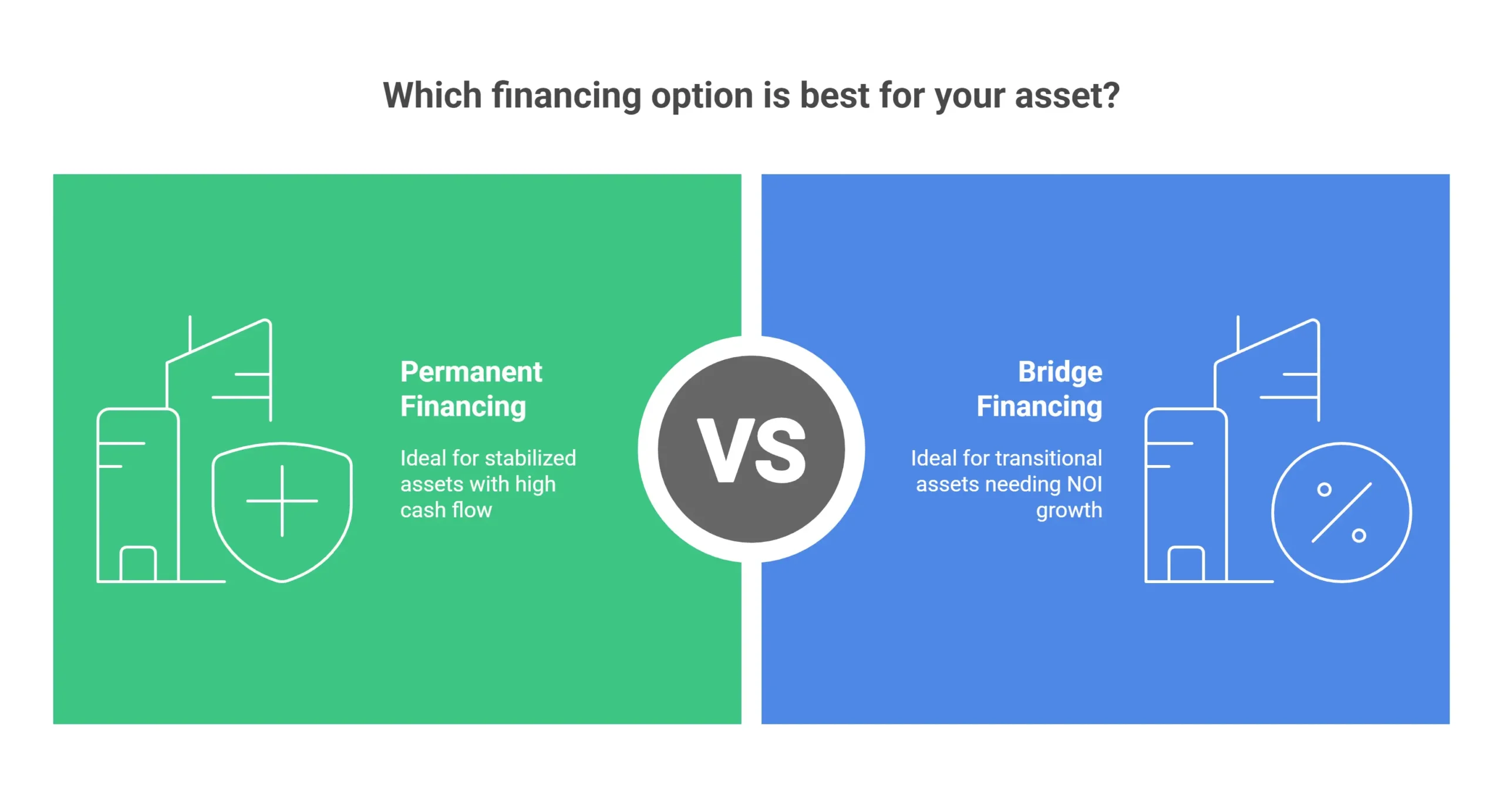
Difference Between Bridge Loan and Permanent Financing CMBS: The Key is NOI Growth
The fundamental difference between bridge loan and permanent financing CMBS alternatives lies in their purpose:
- Permanent Financing (CMBS, Bank Loan, Agency Debt): Designed for stabilized assets that already generate high, predictable cash flow (high DSCR).
- Bridge Financing (Private Capital): Designed for transitional, value-add assets that require a capital injection to increase NOI, thus raising the DSCR to qualifying levels.
A private bridge loan underwritten by experts like ResidentialLender.Net focuses not on your current, failed DSCR, but on the projected DSCR after you execute your business plan.
What is a Private Bridge Loan CMBS? A Quick Close Private Bridge Loan CMBS Solution
A private bridge loan for maturing CMBS debt is a short-term, interest-only loan that “bridges” the financing gap between your current balloon payment and your ability to secure new, permanent debt.
Private Capital for CMBS Debt Extension: Speed and Flexibility
If your property is a residential investment such as a multifamily building, a fix-and-rent portfolio, or a mixed-use property you need capital that moves as fast as the market. That is the core advantage of private capital for CMBS debt extension.
The Strategic Advantages of Private Bridge Loans:
| Feature | Private Bridge Loan Advantage |
| Speed of Close | Quick close private bridge loan CMBS funding can be secured in days or weeks, allowing you to pay off the CMBS balloon before default. |
| Underwriting Focus | Focuses heavily on the property’s current and projected value, as well as the exit plan (the future DSCR). |
| Flexibility | Terms can be customized. Funds can be released for renovations, lease-up costs, or property stabilization. |
| Payment Structure | Typically, interest-only payments keep more cash flow in your hands to execute the value-add plan. |
| Recourse | More flexible recourse options, often focused primarily on the asset’s value. |
Private Bridge Loan Providers Specializing in CMBS: Expertise Matters
Not all bridge loans are the same. A key distinction must be made between a private commercial bridge loan and a traditional hard money loan. While both are short-term, a commercial private bridge loan to mature CMBS debt is usually provided by more experienced lenders with superior resources and expertise.
At ResidentialLender.Net, our 30 years of underwriting experience means we structure the bridge loan with the permanent financing exit already in mind. We are table and correspondent lenders, giving us direct access to institutional capital and a network of 1000 private lenders and investors a depth of funding that few can match. This specialized focus ensures your temporary loan is a professional tool, not a desperate measure.
How to Secure Private Bridge Loan for Commercial Real Estate CMBS: Eligibility and Underwriting
Successfully securing a private bridge loan for maturing CMBS debt depends on presenting a clear, realistic business plan. The process is faster than traditional lending, but disciplined underwriting remains crucial.
Private Bridge Financing for CMBS Loan Maturity: The Process
Unlike a bank loan that might take months to close, the private bridge loan process for CMBS maturity is streamlined because the focus shifts from a rigid credit check to the asset’s viability.
Key Steps in the Private Bridge Loan Process:
- Present the Maturing Debt Problem: Clearly outline the CMBS maturity date and the reason for the DSCR failure.
- Submit Your Business Plan: This is the most critical step. Detail your strategy for increasing NOI whether it’s filling vacancies, completing renovations (fix-and-flip, fix-and-rent), or implementing new management.
- Property Evaluation: Our private bridge loan providers will perform a thorough review of the current and projected property value. For residential investment properties, we assess market strength and demand.
- Borrower Experience Review: Your track record with similar residential investment or multifamily projects, as well as your past loan performance, is reviewed. Unlike a bank, we focus on practical experience and future ability, not just a credit score.
- Finalizing the Exit Strategy: The loan is underwritten based on a credible path to permanent financing, typically a DSCR loan or a sale.
Private Bridge Loan Eligibility CMBS: Focusing on Asset Value
When evaluating private bridge loan eligibility CMBS scenarios, private lenders focus heavily on the collateral (the property) and the borrower’s plan to increase its value:
| Eligibility Factor | ResidentialLender.Net Bridge Loan Guideline |
| Property Type | Residential Investment, Multifamily, Mixed-Use, Rental Portfolio, Fix-and-Flip/Rent. |
| Maximum LTV (Loan-to-Value) | Typically up to 75% LTV on the pro-forma stabilized value. |
| Loan Term | Short-term, usually 6 months to 3 years, with optional extensions. |
| DSCR Requirement | Minimal in-place DSCR is required for floating-rate loans, with focus instead on future DSCR. |
Suppose you have sufficient equity in the property and a well-defined plan to boost your NOI. In that case, you meet the fundamental eligibility criteria for a private bridge loan for maturing CMBS debt.
Difference Between Bridge Loan and Permanent Financing CMBS: The DSCR Loan Exit
A bridge loan is merely a tool; the success of the strategy depends on the exit. For residential investment property owners, the most efficient and powerful exit is often the DSCR loan.
Financing for Maturing CMBS Debt Alternative: Bridge Loan Lenders for Maturing CMBS
Once your property is stabilized (renovated, leased up, and generating higher income), the improved NOI translates directly into a higher DSCR. This is the moment you transition to permanent financing.
DSCR Loans as the Ideal CMBS Refinancing Exit:
- Focus on Property Cash Flow: DSCR loans are perfect because they focus almost entirely on the property’s cash flow and the healthy DSCR you’ve achieved, not on the borrower’s personal income documentation. This makes them a faster, less restrictive path than traditional bank mortgages.
- Bridge-to-DSCR Strategy: Our approach is the strategic “bridge-first” model. The bridge loan provides the capital for the value-add work. Once the NOI is maximized, we immediately place the permanent, low-rate DSCR loan, paying off the bridge debt.
- No Prepayment Penalty Advantage: We structure our bridge loans with no prepayment penalty, allowing you to refinance as soon as you hit your DSCR target and avoid unnecessary interest accumulation.
As bridge loan lenders for maturing CMBS, we offer full-spectrum financing, meaning we can fund the bridge loan, oversee the repositioning, and then secure the long-term DSCR loan, providing a seamless transition. This integrated service avoids the costly delays and complications that arise when working with separate lenders for each phase.
Next Steps: Partnering with Private Bridge Loan Providers Specializing in CMBS
The 2025 maturity wall is not a time for hesitation. It requires immediate, authoritative action from investors who need to deploy private bridge loans to replace maturing CMBS debt funding and protect their assets.
Best Private Bridge Loan Rates for CMBS and How Our Expertise Helps
While private bridge loans generally carry higher interest rates than permanent mortgages (typically ranging from 8% to 13%, with 2% to 5% in points), these costs are justified by the speed, flexibility, and value creation they enable. The temporary premium is a small price to pay to avoid default or the losses associated with a forced sale.
Why Choose ResidentialLender.Net?
- 30 Years of Underwriting Capability: We bring three decades of expertise in complex debt structures, giving us the authority to structure a private bridge financing for CMBS loan maturity plan that works.
- Table and Correspondent Lender: Our position gives us direct access to institutional capital and the agility of a private firm, enabling us to deliver a quick-close private bridge loan CMBS solution when time is running out.
- Full-Spectrum Lending: We offer the financing for maturing CMBS debt alternative you need, including the final DSCR or term loan exit, providing continuity and certainty of execution.
Suppose you are an experienced or new real estate professional an investor, broker, or realtor with residential assets that are due a balloon payment. In that case, the window for traditional refinancing is closing. A specialized private bridge loan for maturing CMBS debt is the most strategic tool to secure your asset’s financial future.
Contact ResidentialLender.Net today. We will analyze your maturing CMBS loan, detail your path to stabilization, and structure the private capital for CMBS debt extension you need to successfully bridge the gap to permanent solvency.
FAQs
1. Since my CMBS loan had non-recourse features, will my personal credit history or income still matter for a private bridge loan?
Answer: Private bridge loan providers focus primarily on the collateral the residential investment property and its future potential, rather than on your personal income or credit score, as traditional banks do. While we review your experience with similar projects and your credit history, our underwriting is practical, not restrictive. The main factors are the property’s current value, its projected value after stabilization, and the clarity of your plan to pay off the loan. This flexible underwriting makes the private bridge loan a viable option even if strict bank documentation rules or credit issues prevent traditional refinancing.
2. I’ve heard the term “hard money.” Is a commercial bridge loan the same thing as a hard money loan?
Answer: Not exactly. They share similar characteristics both are short-term, asset-secured, and have higher interest rates than permanent loans. However, a private commercial bridge loan is typically used by more experienced investors to stabilize income-producing assets (like apartment buildings) with a specific, planned path to permanent refinancing (the DSCR loan exit). Hard money loans often focus purely on the property’s current value. They are more frequently used for urgent, equity-based fix-and-flip scenarios. As expert bridge lenders, we structure the loan around your long-term exit strategy, offering superior project evaluation and financial strength compared to basic hard-money providers.
3. If my CMBS loan falls into special servicing, can a private bridge loan still help me avoid foreclosure?
Answer: Yes, decisively. Suppose your loan is transferred to special servicing. In that case, the special servicer’s job is to maximize recovery for bondholders, often resulting in costly fees and complex workout negotiations. A private bridge loan to refinance maturing CMBS debt serves as a rapid intervention tool. Because private lenders can execute a quick close private bridge loan CMBS, we can provide the full amount necessary to pay off the maturing CMBS balloon debt before the special servicer can force a sale or a foreclosure process, thereby protecting your investment.
4. What exactly are the “points” charged on a private bridge loan, and what do they cover?
Answer: The “points” you see advertised (often ranging from 2% to 5%) are generally the origination fees for the bridge loan. These fees are typically paid at closing and are used to compensate the lender for the specialized nature of the financing, including the high-speed funding, the customized underwriting for a transitional property, and the elevated risk involved. Depending on the agreement, these points may also cover extension fees if you need more time to stabilize the property before securing long-term financing.
5. If my residential property needs major renovations to boost rent and cash flow, can the bridge loan include funds for those capital improvements?
Answer: Yes, absolutely. Unlike many traditional lenders, private bridge loans are designed explicitly for transitional or value-add properties. When we structure the financing, we can include capital reserves within the loan proceeds to cover necessary repairs, renovations, or tenant improvements. This is a critical advantage, as it allows you to use bridge capital to increase the property’s Net Operating Income (NOI), thereby helping the asset meet the DSCR requirement for the permanent refinancing exit.