 Google AI
 ChatGPT
 Perplexity
The year 2026 has brought a massive shift to the American real estate market. Financial experts are calling it the “Maturity Wall.” Right now, about $875 billion in commercial real estate debt is reaching its due date. This means thousands of investors are forced to refinance amid rising interest rates and shifting property values. If you are an investor, you might feel the “Invisible Tax” of these higher rates, where a property that made money in 2021 suddenly starts losing it after a refinance.
At ResidentialLender.Net, we have spent 30 years as expert underwriters. We are a “table and correspondent lender” with a network of over 1,000 private lenders and investors. We know that in this “variable market,” your best defense is a financial shield. That shield is the non-recourse loan.
This blog explains exactly what non-recourse commercial loan requirements look like today. Whether you are doing a fix-and-flip or managing a large multifamily portfolio, understanding these rules is the difference between protecting your family’s future and putting everything you own at risk.
Can You Truly Protect Your Personal Wealth? Non-Recourse vs Recourse Commercial Loan Private Lender Pros and Cons
The biggest question every investor asks is: “What happens if the deal goes south?” The answer depends on whether your loan is “recourse” or “non-recourse.”
In a recourse loan, you are personally on the hook. If the property doesn’t sell for enough to cover the debt, the lender can legally seize your bank accounts, your cars, and even your primary home. It is a “full-liability” promise.
A non-recourse loan is different. It limits the lender’s recovery only to the property itself. If you default, the lender takes the building, but they cannot touch your personal savings or assets.
| Feature | Recourse Loan | Non-Recourse Loan |
| Personal Liability | Full (Wages, Home, Savings) | None (Limited to Collateral) |
| Interest Rates | Generally lower (by 0.5% to 2%) | Generally higher |
| Down Payment | 15% to 25% | 30% to 40% |
| Credit Scrutiny | Focuses on You | Focuses on the Property |
While non-recourse loans offer incredible “pleasure” through asset protection, they come with stricter rules. Private lenders take on more risk here, so they expect the property to be a “fortress” of cash flow.
Is Your Property Strong Enough to Stand Alone? Non-Recourse Commercial Real Estate Loan Eligibility Private Lender Standards
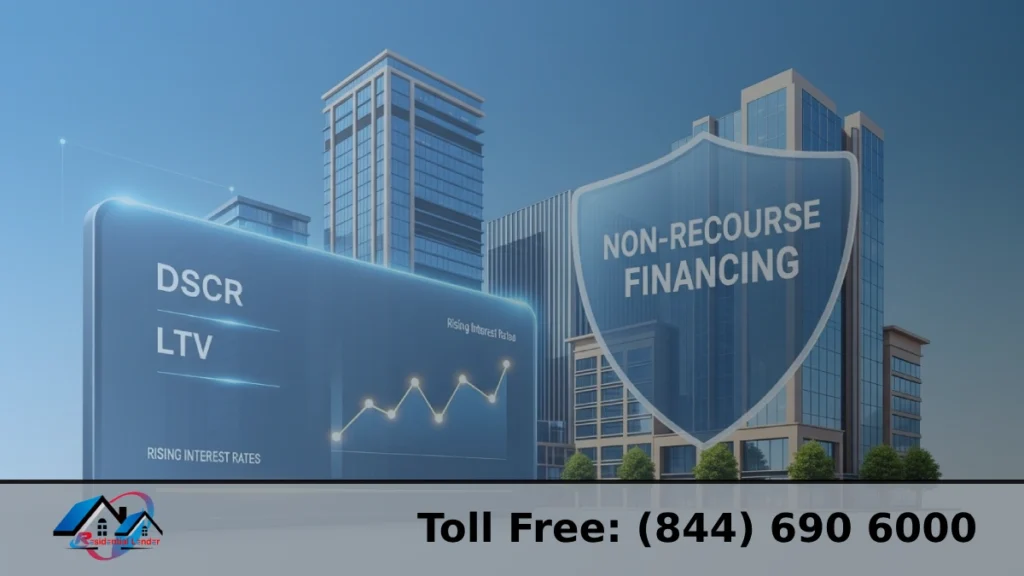
To qualify for a non-recourse loan, your property must prove it can pay its own bills. Private lenders look at two main numbers: LTV and DSCR.
The Loan-to-Value (LTV) Ratio
For non-recourse debt, lenders want to see “over-collateralization”. This means they won’t lend you the full price. In 2026, most non-recourse commercial real estate loan eligibility private lender standards require an LTV between 65% and 75%. You will need to bring a down payment of 25% to 35%. If the property value is under $100,000, some lenders cap the LTV at 70% to lower their risk.
The Debt Service Coverage Ratio (DSCR)
This is the most important math in the building. It measures whether the property’s income can cover the mortgage. The formula we use is:
DSCR = Net Operating Income (NOI)}/ {Annual Debt Service}
Most private lenders require a DSCR of 1.25 or higher. This means for every $1.00 of mortgage payment, the property must make at least $1.25 in profit. If you are looking at a high-performing property with a DSCR of 1.50, you have a much better chance of negotiating great terms.
Why Private Lender Non-Recourse Multifamily Loan Requirements are the “Gold Standard”
Multifamily properties—like apartment buildings with 5 or more units—are the favorites for non-recourse financing. Why? Because people always need a place to live. Even in 2026, the multifamily sector shows “positive net demand”.
To meet private lender non-recourse multifamily loan requirements, your building usually needs to be “stabilized.” This means it should have at least 90% occupancy for the last 90 days. Lenders will look at:
- Tenant Strength: Are the leases long-term and signed by reliable people?
- Management Experience: Lenders want to see that you (or your team) have at least two years of experience managing multifamily housing.
- Location: Assets in “growth cities” like Dallas or Tampa get better treatment than those in shrinking markets.
Does Your Credit Score Still Matter When the Property Is the Collateral? Minimum Credit Score for Non-Recourse Private Commercial Loan
It is a myth that non-recourse lenders don’t care about your credit. While they focus on the property, your score tells them if you are a “trustworthy partner.”
In the current market, the minimum credit score for approval of a non-recourse private commercial loan is usually 680-700. If your score is 720 or higher, you can unlock better interest rates and lower fees.
Lenders look for:
- A history of on-time payments.
- Low credit utilization.
- No recent bankruptcies or foreclosures (usually within the last 5-7 years).
Applying for a Non-Recourse Commercial Loan with Bad Credit Private
What if your credit isn’t perfect? You can still succeed by applying for a non-recourse commercial loan with bad credit private strategies. This usually involves “compensating factors.” You should provide a down payment of 40% to 50%, or show that you have 12 months of cash reserves in the bank to cover the mortgage. At ResidentialLender.Net, our underwriting expertise helps us find the “story” behind the numbers so you can get funded.
What Collateral is Needed for a Non-Recourse Commercial Loan Requirements Private
Not every building qualifies for non-recourse debt. Lenders want “strong” assets. Common property types include:
- Industrial & Warehouse: Very popular in 2026 due to the “reshoring” of manufacturing.
- Mixed-Use: Buildings with shops on the bottom and apartments on top.
- Self-Storage & Mobile Home Parks: These are considered “recession-resistant”.
- Data Centers: A huge trend in 2026, with AI-related investment expected to exceed $500 billion.
Lenders typically avoid “special purpose” properties like cemeteries or bowling alleys unless you have massive experience and a huge down payment. They also prefer properties built after 1940.
Will Private Lenders Take a Chance on Your Distressed Asset? Non-Recourse Bridge Loan Eligibility: Private Financing
If you find a “fix-and-flip” or a “fix-and-rent” property that isn’t making money yet, a standard non-recourse loan won’t work. You need a non-recourse bridge loan.
These are short-term loans (usually 12 to 36 months) used to “bridge” the gap until the property is repaired and rented out. The requirements focus heavily on your Exit Strategy. You must show exactly how you will repay the loan—either by selling the property or refinancing it into a long-term loan once it is “stabilized”.
Private hard money non-recourse commercial loan terms for bridge deals often include:
- Interest-only payments (to keep your costs low during construction).
- Higher interest rates (8% to 12% is common in 2026).
- Funding for 70% to 80% of the “After Repair Value” (ARV).
Navigating the Technical Side: Private Lender Non-Recourse Construction Loan Requirements
Building from the ground up is the riskiest move in real estate. Most construction loans require a personal guarantee, but some private programs—including specialized FHA and HUD options—offer non-recourse structures.
To meet private lender non-recourse construction loan requirements, you need:
- Guaranteed Maximum Price (GMP) Contracts: A promise from your builder that costs won’t spiral out of control.
- Contingency Reserves: Lenders often require you to set aside 10% of the budget for “surprises,” such as rising labor or material costs.
- Pre-Leasing: For retail or office projects, you might need to show that 50% of the space is already “spoken for” by future tenants.
Due Diligence for Non-Recourse Commercial Loan Private Lender
When a lender can’t come after your personal assets, they check the property twice as hard. This is the “Due Diligence” phase. It usually takes 30 to 90 days.
The due diligence for a non-recourse commercial loan private lender audit includes:
- Phase I Environmental Report: Checking for soil or water pollution.
- Property Condition Assessment (PCA): A professional look at the roof, HVAC, and structure.
- Title Search: Ensuring there are no “hidden” liens or legal fights over the land.
- Rent Roll Audit: Verifying that every tenant is actually paying the rent they claim.
How long does it take to get a private non-recourse commercial loan? While banks take months, our correspondent network can often get you from application to closing in 30 to 45 days if your paperwork is organized.
Benefits of Non-Recourse Commercial Loans from Private Sources
Why choose a private source over a big bank? In 2026, banks are “scaling back” amid concerns about their own risks. Private lenders are filling that gap with faster and more flexible options.
- Asset Protection: Your family is safe if the market crashes.
- No “Bad-Boy” Worries: As long as you don’t commit fraud or “malfeasance,” you stay protected.
- Longer Terms: Many private programs offer 25- to 30-year amortization, which results in much smaller monthly payments.
- Confidentiality: Private loans don’t always show up on your personal credit report in the same way bank loans do, keeping your borrowing power high.
Refinancing Strategies for the 2026 “Maturity Wall”
If you have a loan coming due this year, you need a plan for non-recourse commercial real estate refinancing options with private lenders. The goal is to “shield” your equity before the next market shift.
According to Harvard’s Joint Center for Housing Studies, 50% of all renters are now “cost-burdened,” meaning they spend over 30% of their income on rent. This makes “tenant satisfaction” and “operational management” the keys to a successful refinance. If you can lower your utility bills or improve the building with smart technology, your NOI goes up, your DSCR improves, and you qualify for better refinancing terms.
The 2026 Economic Outlook: Insights from Harvard, Oxford, and the Fed
We base our advice on hard data. Here is what the leading institutions are saying about 2026:
- Oxford Economics: Expects a “revival” in real estate activity as supply stays low, which supports higher rents.
- Federal Reserve: Reports that banking conditions are stable, and demand for commercial lending is slowly increasing.
- Forbes & Investopedia: Highlight that “strategic lending” and “boots on the ground” expertise are the only ways to win in a variable market.
- Harvard (JCHS): Predicts that homeowner spending on improvements will reach a record $524 billion in 2026, signaling a strong desire to add value to existing properties.
Take Action Today with ResidentialLender.Net
The “Maturity Wall” is a challenge, but it is also an opportunity. Investors who move early to secure non-recourse debt are the ones who will own the next generation of Class A assets.
At ResidentialLender.Net, we offer exclusive referral programs for both new and experienced brokers. We offer bridge loans, DSCR loans, USDA B&I loans, and no-doc options. With 30 years of expertise, we don’t just find you a loan; we find you a future that is protected.
Are you eligible? Don’t wait for the “Invisible Tax” of rising rates to eat your profits. Contact us today to audit your portfolio and see how non-recourse financing can build your personal fortress.
FAQs
Can I use an IRA for loans?
Yes. For self-directed IRA investments, non-recourse financing is required by law because the IRS prohibits personal guarantees on these accounts. Lenders often require a 40-50% down payment and specific entity structures to satisfy these unique federal regulations.
Do non-recourse loans have prepayment penalties?
Yes. Most non-recourse structures, especially CMBS and life company loans, include yield maintenance or defeasance clauses to protect lender profits. You might face a lockout period where early repayment is prohibited, or a declining step-down fee over several years.
Is secondary financing allowed on these loans?
No. Most non-recourse lenders prohibit subordinate debt or secondary liens to ensure the primary collateral remains unencumbered. Unauthorized subordinate financing is a common “bad boy” carve-out trigger that can instantly nullify your personal liability protection and trigger full recourse.
Are construction loans typically non-recourse today?
No. Most traditional bank construction and bridge loans are structured on a full-recourse basis because ground-up development carries higher completion risks. Non-recourse options are generally limited to specific government-backed programs like HUD 221(d)(4) or specialized private capital for highly experienced developers.
Can multiple properties qualify for one loan?
Yes. Portfolio non-recourse loans allow you to cross-collateralize several assets under a single facility to maximize your leverage. Lenders typically require a minimum of 2 to 10 properties, with individual valuations and a consolidated debt service coverage ratio.